Lumyros: Aurora App & Social
- 1.7
- Rating
- 10.00K
- Installs
- Free
- Price

 Analysis by App-foxy
I approached Lumyros: Aurora App & Social as a decision rather than a simple download recommendation. Aurora apps can serve very different purposes: some are mainly forecast tools, some are visual sky guides, and others try to build a community around sightings. This app sits closest to the third group while still presenting itself as a weather app. That distinction matters, because the right choice depends on whether you want a quick answer about tonight’s conditions, a place to follow other Northern Lights hunters, or a more social way to stay interested in aurora activity.
My first impression is that the app is aimed at people who enjoy the hunt itself. The Northern Lights are unpredictable, and part of the fun is checking conditions, comparing expectations with what people are seeing, and deciding whether it is worth stepping outside. Lumyros makes sense for that mindset. It is less obviously suited to someone who only wants a bare forecast and no extra layer around it.
How I would decide whether Lumyros fits
I’d decide whether Lumyros fits by giving it a few real chances to support an evening plan, rather than judging it on a single glance. I’d note whether it changes what I do—such as helping me choose a nearby viewing spot or avoid an unnecessary drive—and whether I still want to open it once the initial curiosity wears off. That practical test is a better measure of lasting value than novelty alone.
You May Also Like

 Pandora - Music & Podcasts
Pandora’s Music Is Easy to Start, but Harder to Recover
Pandora’s strength is its low-effort path from a seed to a station. Its weak spot is how much confidence it asks you to place in connection, setup, and quiet recovery.

 AccuWeather: Weather Radar
AccuWeather Review: A Quick, Clear Forecast for Everyday Decisions
For everyday plans, the best forecast is the one you can understand quickly. AccuWeather makes rain timing, radar, and local conditions easy to act on, with a few trade-offs.

 Hill Climb Racing
Why Hill Climb Racing Still Turns Crashes Into One More Run
A tiny car, a bumpy hill and one more upgrade: Hill Climb Racing keeps resurfacing because its simple chaos makes every near-miss feel personal.

 AliExpress - Shopping App
AliExpress Makes Global Shopping Feel Personal, but Shoppers Bear the Risk
AliExpress turns a global marketplace into a pocket-sized discovery engine. Its reach is useful, its shopping loop compelling, and its trade-offs easy to miss.

 Lords Mobile: Kingdom Wars
Lords Mobile Is a Kingdom-Building Routine, Not a Quick Match
A case-by-case verdict on the building, battles, device demands, and social commitments that make Lords Mobile rewarding for some players and exhausting for others.

 PDF Scanner app - TapScanner
TapScanner Makes Paperwork Easier to Capture, Check, and Share
TapScanner makes scanning with a phone feel less like a rescue operation and more like a dependable step in getting work done. Its capture tools are useful, though not flawless.
More From Our News Desk
View All News


Start with the kind of information you actually need
Before installing any aurora app, I would ask one practical question: do I need a forecast, or do I want an experience built around chasing the aurora? If the answer is purely forecast, a standard weather service may already cover the basics of clouds, temperature, wind and precipitation more efficiently. If the answer includes discovery, conversation and the excitement of watching for possible sightings, Lumyros becomes more interesting.
The app is free to download, which makes trying it relatively easy. It is rated for Everyone, and it runs on Android devices using version 6.0 or later. That broad compatibility is useful if you have an older phone that still works well but cannot handle some newer apps. I would still keep expectations realistic: an older operating system may not provide the same smoothness as a recent device, and the app’s usefulness will depend more on the quality of its current experience than on compatibility alone.
Lumyros comes from developer Jan Svamberg and has reached over ten thousand installs. That gives it a real user base without making it feel like a dominant mainstream weather platform. I see that as a mixed signal. There are enough people using it for the social idea to have some relevance, but it is not the kind of service I would assume has the depth or reach of the biggest weather brands.
Use the rating as a reason to test, not as a final verdict
The average rating is 1.7 from around two dozen ratings, with four written reviews. That is a weak public reception, and I would not ignore it. At the same time, a small rating pool can be heavily influenced by a handful of unhappy experiences. I would treat the score as a warning to test the app personally rather than as proof that every user will have the same reaction.
My practical approach would be to install it before a planned aurora trip, not during the trip. Spend a few evenings learning whether the interface gives you information in a way you understand, whether the social side feels useful, and whether the app fits naturally into your routine. That trial period is more valuable than relying on the store score alone.
Separate excitement from dependable planning
Aurora chasing involves several layers of uncertainty. Even a promising forecast does not guarantee a visible display from your exact location. Clouds, light pollution, local visibility and timing can all change the result. I would therefore use Lumyros as one part of a decision process, not as a promise that the sky will perform.
This is one of the most important trade-offs. A friendly community can make the hobby more engaging, but enthusiasm from other users should not replace checking your own conditions. If someone reports activity somewhere else, that may encourage you to look up, yet it does not automatically mean your location has a clear view. I would keep a conventional weather source nearby for local cloud and wind checks, especially when driving or planning a late-night outing.
Where the social approach is genuinely useful
The strongest idea here is the attempt to connect people who are interested in the Northern Lights. For a beginner, that can make the subject feel less technical and less lonely. Instead of staring at unfamiliar forecast information, you can approach the hobby through people who are also watching the sky. The social layer may help turn occasional curiosity into a repeatable interest.
I also think it can be valuable for travelers. If I were visiting a northern destination for only a few nights, I would want more than a generic weather icon. I would want a reason to keep checking, a sense of what other observers are paying attention to, and a simple way to stay engaged while conditions change. Lumyros is conceptually better placed for that kind of trip than a weather app that treats the aurora as just another line in a forecast.
There is a subtle benefit for people who are still learning the difference between a possible event and a visible one. Following an aurora-focused community can encourage better habits: checking the sky personally, comparing reports with local conditions, and becoming more patient about timing. The app’s value may therefore grow over several nights instead of being obvious after one quick launch.
Where it may beat a conventional weather app
A normal weather app is usually designed around everyday decisions such as commuting, rain, temperature and severe weather. It can be faster when I only need to know whether the sky will be cloudy later. Lumyros has a narrower identity, and that focus may make it more appealing to someone who thinks of weather as part of an outdoor pursuit rather than a daily utility.
The difference is not simply the presence of an aurora topic. It is the way the app frames the activity around people who are actively hunting for the lights. That can make repeated checking feel purposeful. Instead of opening a general forecast and searching through unrelated panels, an aurora enthusiast has a dedicated place to return to.
That said, I would not replace a reliable general weather service with Lumyros. The two tools answer different questions. I would use a standard weather app for local conditions and travel safety, then use Lumyros for the aurora-focused part of the decision. That combination is more sensible than demanding that one app handle every detail.
Practical routines that make the app more useful
My preferred routine would be to check the app earlier in the day, identify whether the evening looks worth monitoring, and then make a second check before going outside. This avoids the common mistake of treating an early possibility as a fixed appointment. I would also compare what I see in the app with the actual sky outside rather than waiting passively for a perfect alert or a dramatic event.
A second useful habit is to keep a personal threshold. For example, I might decide that I will only travel farther when the forecast looks promising and local cloud conditions are favorable. On weaker nights, I would stay close to home and treat the outing as an experiment. This prevents the social excitement from turning every uncertain forecast into an expensive or exhausting trip.
A third tip is to use the community as context, not authority. Reports from other hunters can tell me that people are paying attention, but they should not override what I can see from my own location. The farther away another observer is, the less directly their experience applies to my sky. That simple distinction can save a lot of wasted travel.
Where the experience may create friction
The public rating makes me cautious about polish, reliability and the clarity of the user experience. I cannot recommend installing it blindly and assuming everything will feel effortless. A social weather app has to do two jobs well: present useful information and make interaction worthwhile. If either side feels confusing or quiet, the whole concept becomes less convincing.
There is also a natural tension between friendliness and precision. Beginners may appreciate a welcoming presentation, while experienced aurora watchers may want more technical detail and less conversation. If you already have a carefully developed forecasting workflow, Lumyros may feel like an extra destination rather than an improvement. In that case, the social element has to offer enough value to justify another app on your phone.
The in-app purchase range runs from $0.99 to $99.99 per item. Because the app is free to start, I would pay close attention to what is available without spending and what, if anything, is placed behind purchases. I would not pay simply because the app is aurora-themed. I would first use the free experience long enough to decide whether it improves my planning or merely adds another stream of information.
Who should choose an alternative instead
I would steer a purely practical user toward a conventional weather app if the main need is dependable local forecasting for work, commuting or outdoor safety. Lumyros is not the obvious first choice for someone who has no interest in the Northern Lights community. Its focus is too specific to justify the switch when a general weather tool already covers the daily essentials.
I would also suggest looking elsewhere if you are an advanced observer who wants a highly technical instrument above all else. A social-first approach may not satisfy someone who prefers detailed scientific indicators, carefully organized historical information or a very specialized forecasting workflow. I am not saying Lumyros cannot be useful to experienced users, only that its appeal seems more connected to participation and discovery than to replacing every specialist tool.
Travelers should think about the cost of adding another app to their routine. If you are visiting an aurora region for one short stay, Lumyros could make the experience more engaging, but it should not be the only source used to decide whether to travel at night. If you already have a trusted weather app and a separate aurora resource, the benefit of switching depends on whether the community side gives you something those tools lack.
What switching really involves
Switching to Lumyros is not just a matter of downloading a free app. The real cost is attention. You may need to learn where the useful information appears, decide how much weight to give community activity, and build a habit of checking it alongside local weather conditions. For casual users, that extra step may be unnecessary. For enthusiasts, it can become part of the enjoyment.
There is also a social switching cost. A community app becomes more valuable when it feels active and relevant to your interests. If the people, reports or conversations do not match the places and times you care about, the app may feel less useful than its concept suggests. I would therefore judge it over several checks rather than one opening session.
The current version is 3.3.2, so the app is not presented as an untouched early experiment. That is encouraging, but version numbers alone do not guarantee that every rough edge has been solved. I would still look for a stable routine: can I open it quickly, understand what matters, and leave with a clearer decision about tonight? If yes, the app is earning its place. If not, the free price does not remove the inconvenience.
My recommendation for different types of users
For a newcomer who wants to learn about aurora watching in a more welcoming setting, I think Lumyros is worth trying. The combination of a focused subject and a social angle can make the hobby easier to enter. I would use it during a period when I have several opportunities to look at the sky, because repeated use gives the community and forecasting context more chance to become useful.
For an enthusiast who already checks the Northern Lights regularly, my recommendation is more conditional. Install it if you want a social companion to your existing routine, but do not assume it should replace every other source. Keep your normal local weather checks, use your own judgment, and decide whether the app adds insight or simply duplicates what you already know.
For someone who wants a general weather app, I would skip it. The narrow focus is the point, and that same focus makes it a poor substitute for a broad daily forecast. The low average rating also means I would not recommend paying for extras before establishing that the free experience works well for your needs.
The bottom line after weighing the trade-offs
Lumyros is an interesting idea with a clear audience: people who do not merely want to read a weather forecast, but enjoy being part of the search for the Northern Lights. Its best use is as a companion for repeated aurora watching, especially when you want a more human and social experience than a standard weather screen provides.
My final recommendation is to try it cautiously and judge it by usefulness rather than by the promise of excitement. Use the free version first, combine it with a dependable local weather source, and avoid treating community enthusiasm as a guarantee of visibility. The app is most worthwhile when it helps you make better, calmer decisions about when to look and when to stay home.
I would not call it an automatic recommendation because the public rating is poor and the social concept may not suit everyone. Still, for a curious beginner or an aurora hunter who wants a dedicated community around the hobby, it is worth a test. For precise forecasting, everyday weather needs or highly technical observation, a different category of app will probably serve you better.
FAQs for Lumyros: Aurora App & Social
01What is Lumyros: Aurora App & Social, and what can I do with it?
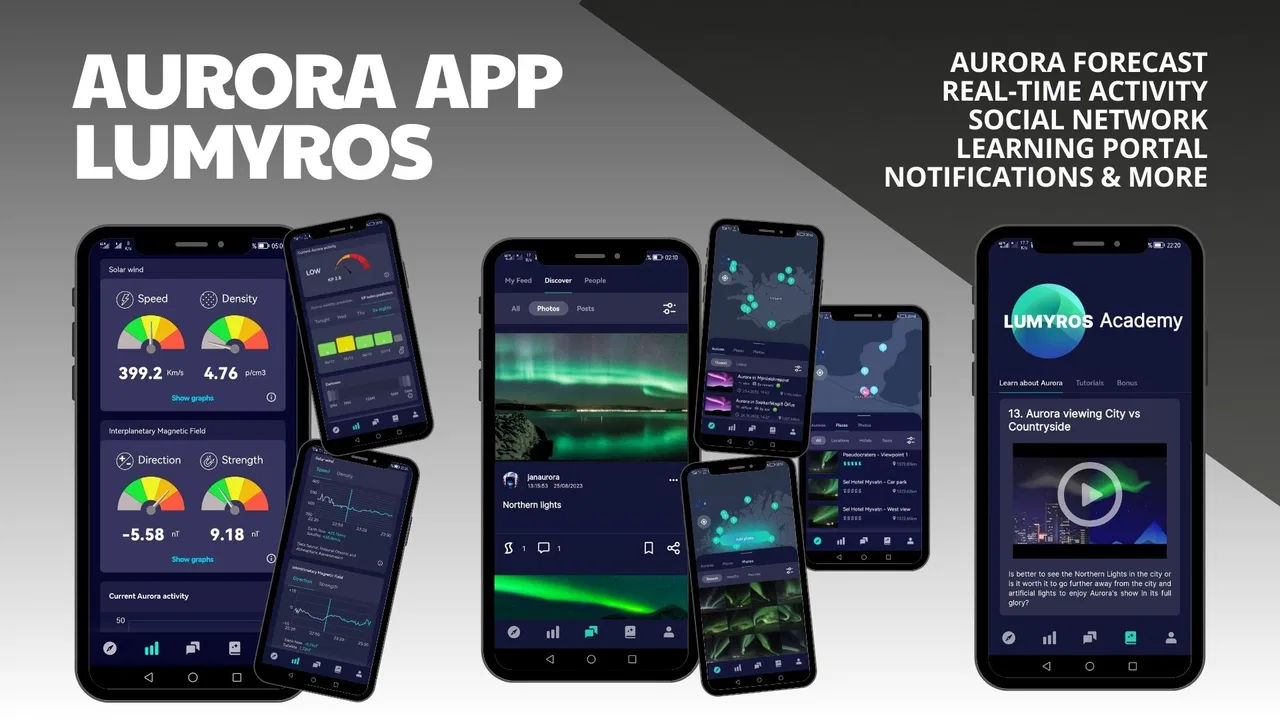
Lumyros: Aurora App & Social is designed around discovering, viewing, and sharing aurora-related content in a social environment. Depending on the available features and your location, you may be able to explore aurora forecasts, follow activity, view visual content, and interact with other users. It is best suited to people interested in the Northern Lights, night-sky photography, and sharing atmospheric outdoor experiences.
02Does Lumyros provide accurate aurora forecasts and real-time alerts?
The app can be useful for monitoring aurora conditions, but forecasts should be treated as guidance rather than a guarantee. Aurora visibility depends on solar activity, cloud cover, light pollution, local weather, and your exact location. Before planning a trip, compare the information in Lumyros with a trusted space-weather or weather service, and remember that alerts may vary in timing and accuracy.
03Does Lumyros: Aurora App & Social require location access?
Location access may be important for features that personalize aurora forecasts, visibility information, nearby activity, or local notifications. You can usually review and change this permission through your device settings. If you prefer not to share precise location data, check whether the app offers approximate or manual location selection. Restricting access may reduce the accuracy of location-based forecasts and alerts.
04Is Lumyros free to download, and are there in-app purchases or subscriptions?
The download may be free, but some features can depend on the app’s current pricing model, including optional subscriptions, premium forecasts, enhanced alerts, or additional social tools. Check the Google Play Store or Apple App Store listing before installing, paying particular attention to trial periods, renewal terms, and cancellation instructions. Prices and available features can differ between Android, iOS, and regions.
05Is Lumyros safe for sharing photos, posts, and personal information?
As with any social application, review the privacy policy and permission requests before creating an account or uploading content. Avoid posting sensitive information such as your home address, travel schedule, or exact private location. Use available privacy and notification controls, choose a strong unique password, and be cautious when interacting with unfamiliar users. Also verify how the app handles uploaded photos and account deletion.
Pros
- Beautiful aurora-inspired interface with a distinctive visual style.
- Social features make it easy to discover and share creative content.
- Useful mood-focused experience for relaxing or finding inspiration.
- Simple navigation makes the main features easy to access.
- Regular content discovery can keep the app feeling fresh.
Cons
- Some features may require an account or social permissions.
- The community experience depends on having active users.
- Notifications could become distracting without careful settings.
- Content quality may vary between different community posts.
- Privacy settings should be reviewed before sharing personal content.

Lumyros: Aurora App & Social
Gallery